
Pine Bluff Directory Years
Pine Bluff has a strong but broken historical run. The Pine Bluff/Jefferson County Library System, or PBJCLS, places nine scanned editions online at no charge. Other institutions hold editions that help fill the spaces between those scans. Publisher names must be checked on each title page. The 1953 volume is an R. L. Polk city directory, while evidence identifies Gulf Directory Company, Baldwin Company, and Commercial Directory Company for other years. Calling every volume a Polk book would erase a real difference in the collection.
| Collection | Years represented | Where kept | Way to use it |
|---|---|---|---|
| PBJCLS scanned directories | 1917, 1922, 1927, 1929, 1931, 1936, 1953, 1958, 1963 | Library Digital Collections | Free online scans |
| Pine Bluff microfilm run | 1908, 1910, 1913, 1927, 1929, 1931, 1936, 1946, 1949, 1953, 1956, 1958, 1960 | St. Louis County Library History & Genealogy | Onsite, subject to library policy |
| White and yellow pages | August 1959 through August 1963 | Library of Congress | Cataloged microform; availability varies |
| Historic newspapers | Assorted runs from the 1820s | PBJCLS | Microfilm reader, staff help, copy orders |
The online sequence is not annual. Bridge missing years with the nearest census, deed, tax roll, telephone book, obituary, or newspaper. A catalog gap does not show that a Pine Bluff resident was absent. It only shows that the available volume cannot answer that year by itself.
Start with the PBJCLS Digital Collections overview. The captured collection screen shows the wider set of local history materials available beside the scanned books.
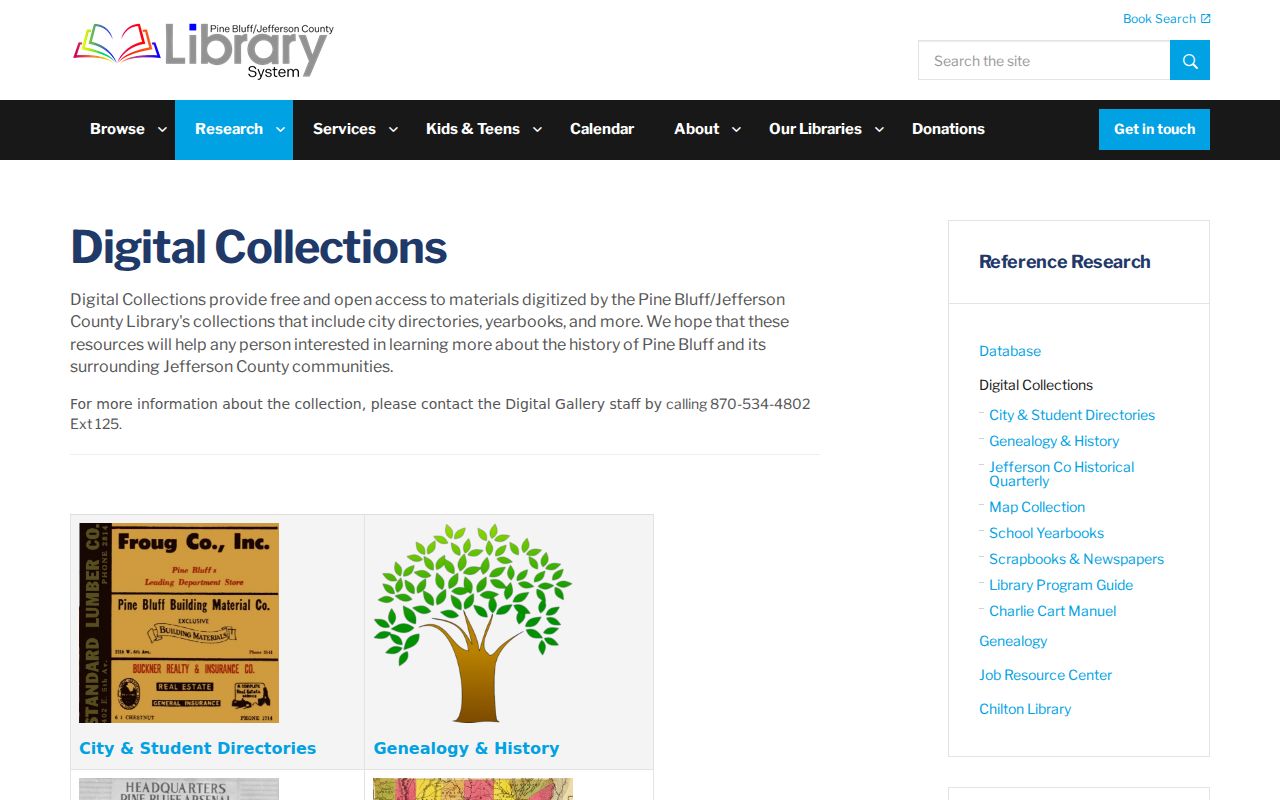
That collection menu matters because a household can move from a directory scan to a yearbook, map, or local periodical without leaving the library's system.
Open Pine Bluff Directories Online
The Pine Bluff city and student directory collection is the direct route to the nine local volumes. The scans are free to view. Collection terms permit research, private study, and a single copy with a citation, while other uses require advance permission. For scan questions or a page that will not load, the Digital Projects contact is 870-534-4802 extension 125.
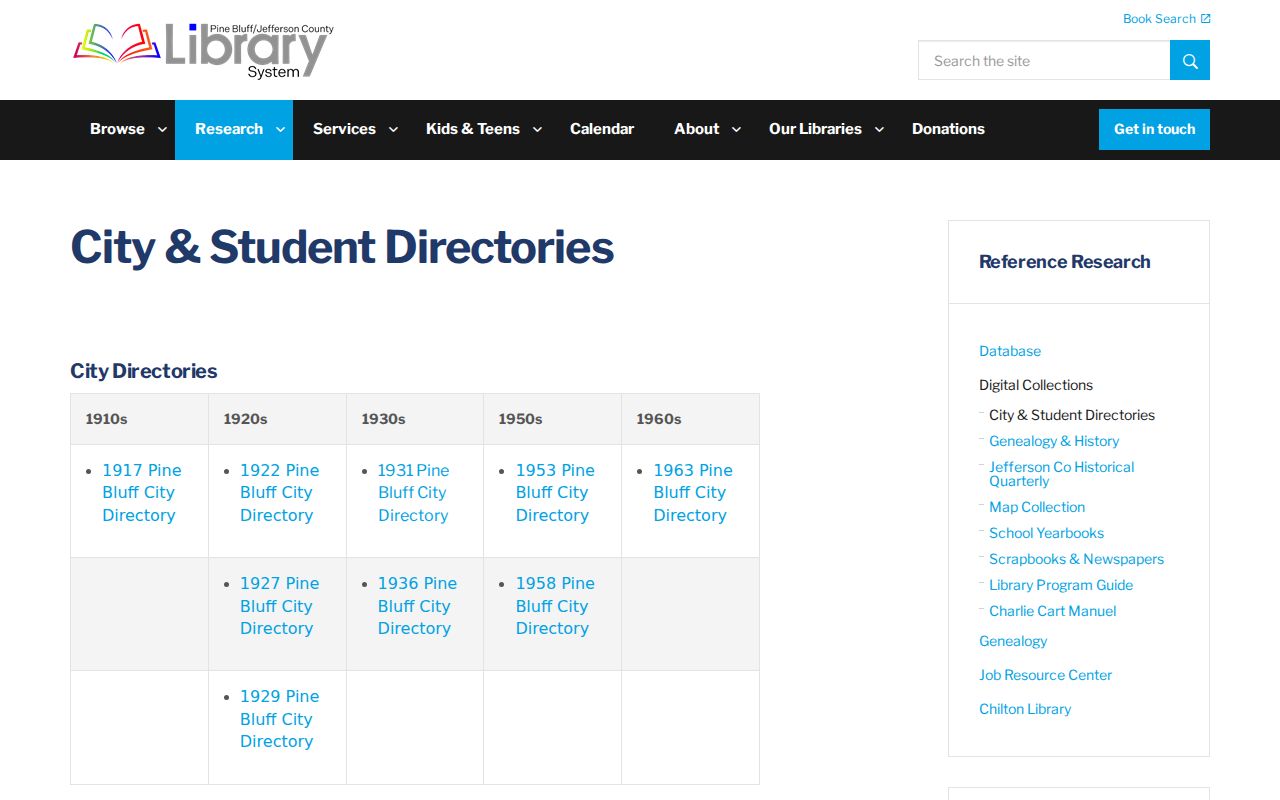
The year choices in the image make the gaps clear. Record the edition, scan image, printed page, and exact spelling for every useful entry. Those details let staff or another researcher return to the same evidence.
Browsing works when optical text search misses an old typeface. Try the surname, a short root of the surname, the spouse's name, and then the street section. If the scan lacks a clean text layer, move through the alphabet by page thumbnails. Search is only a finding aid. The printed image is the source.
Decode a Pine Bluff Directory
A Pine Bluff city directory entry compresses a household into one line. The inspected 1953 pages show a personal name, a spouse in parentheses, a trade or firm, and a street address. They also use short marks such as h for home, r for residence, and wid before a deceased spouse's name. The exact key belongs to that edition, so read its abbreviation page before assigning a meaning.
| Personal name | Surname, given name, middle initial, and sometimes a suffix |
|---|---|
| Household clue | Spouse in parentheses or a widow notation |
| Trade line | Role, craft, firm, or public position as printed |
| Place line | House number, directional, street name, and abbreviated street type |
| Residence mark | A volume-specific symbol such as home or residence |
The searchable 592-page 1953 Polk directory gives a close view of these conventions.
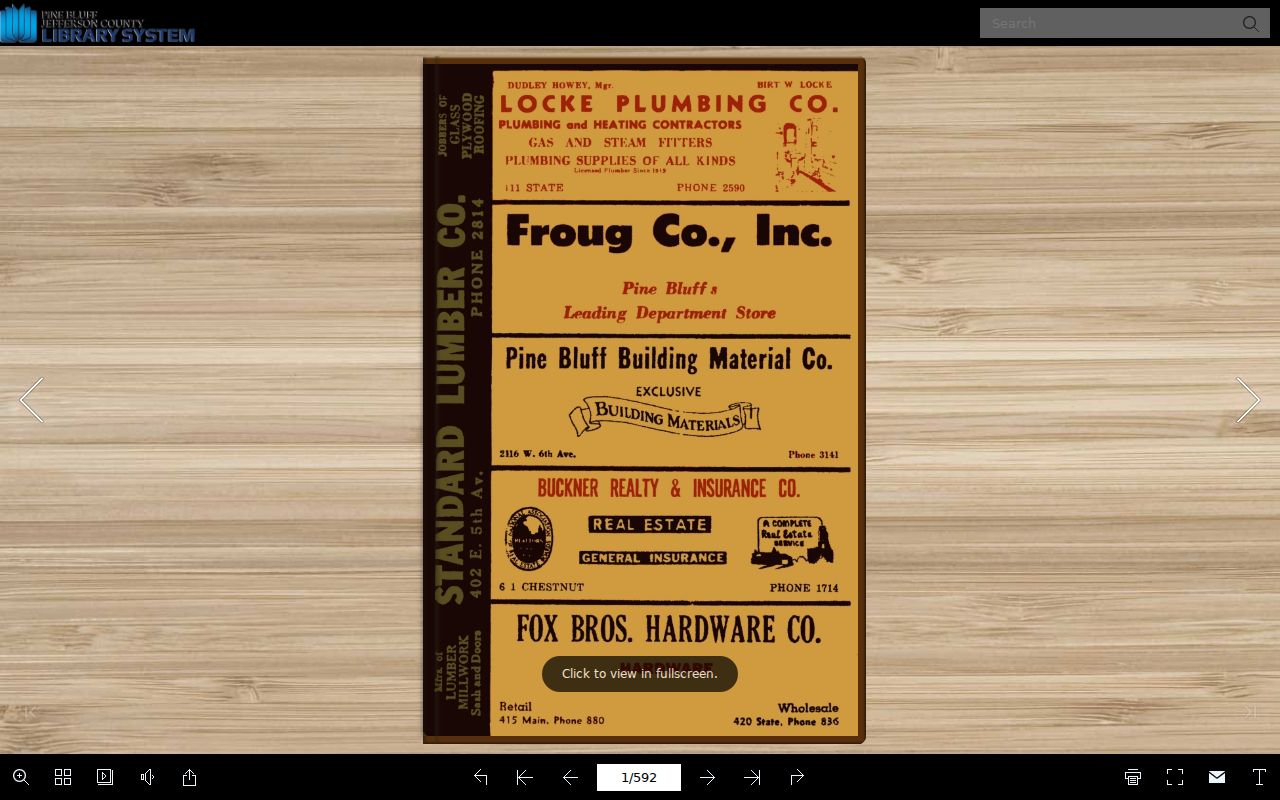
The scan also advertises name, address, street-number occupant, trade, corporate officer, and partner searching. That publisher statement helps explain what the book was designed to reveal.
- Criss-cross directory
- A section arranged by street and house number rather than surname, useful when only an address is known.
- Householder index
- A list keyed to the person associated with a household, which may omit other people at the address.
- Abbreviation key
- The edition's own list of shortened terms and marks. Its definitions control that volume.
Trace Pine Bluff Family Lines
Family history gains strength when each volume is treated as one dated observation. Start near a known event, then move both forward and backward. Keep initials, spouse names, street forms, and the full entry. A second household with the same surname may be a relative, but proximity alone does not prove kinship.
- Find the closest available Pine Bluff edition and save the full entry with its edition and page.
- Check the prior and next available books. Note each change in name form, spouse, trade, and exact address.
- Pair 1917 and 1922 with the 1920 census; use 1927, 1929, and 1931 with 1930; use 1936 with 1940; pair 1953 with 1950.
- Switch to street order to test whether the address stayed the same while the named householder changed.
- If a person vanishes, search the obituary index, newspaper microfilm, probate filings, cemetery sources, and deeds.
The 1950 census is the latest public federal population schedule as of 2026 under the 72-year release rule. The 1960 schedule is due in 2032. Census pages can name a full household and relationships that a Pine Bluff volume compressed or omitted.
Pine Bluff Genealogy Desk
PBJCLS is the main local fallback when the scan shelf runs out. The Main Library is at 600 S. Main St., Pine Bluff, AR 71601, and the main telephone number is 870-534-4802. Its genealogy resources include Jefferson County obituary and genealogy-book indexes, newspapers on microfilm from the 1820s, reader and printer access, staff help, and photocopy orders. Remote researchers can ask staff how to obtain a cited item rather than relying on a name-only search result.
The library's Jefferson County Historical Quarterly adds family sketches, churches, cemeteries, communities, and place history. View the Historical Quarterly collection before assuming an ancestor absent from a directory left no local record.
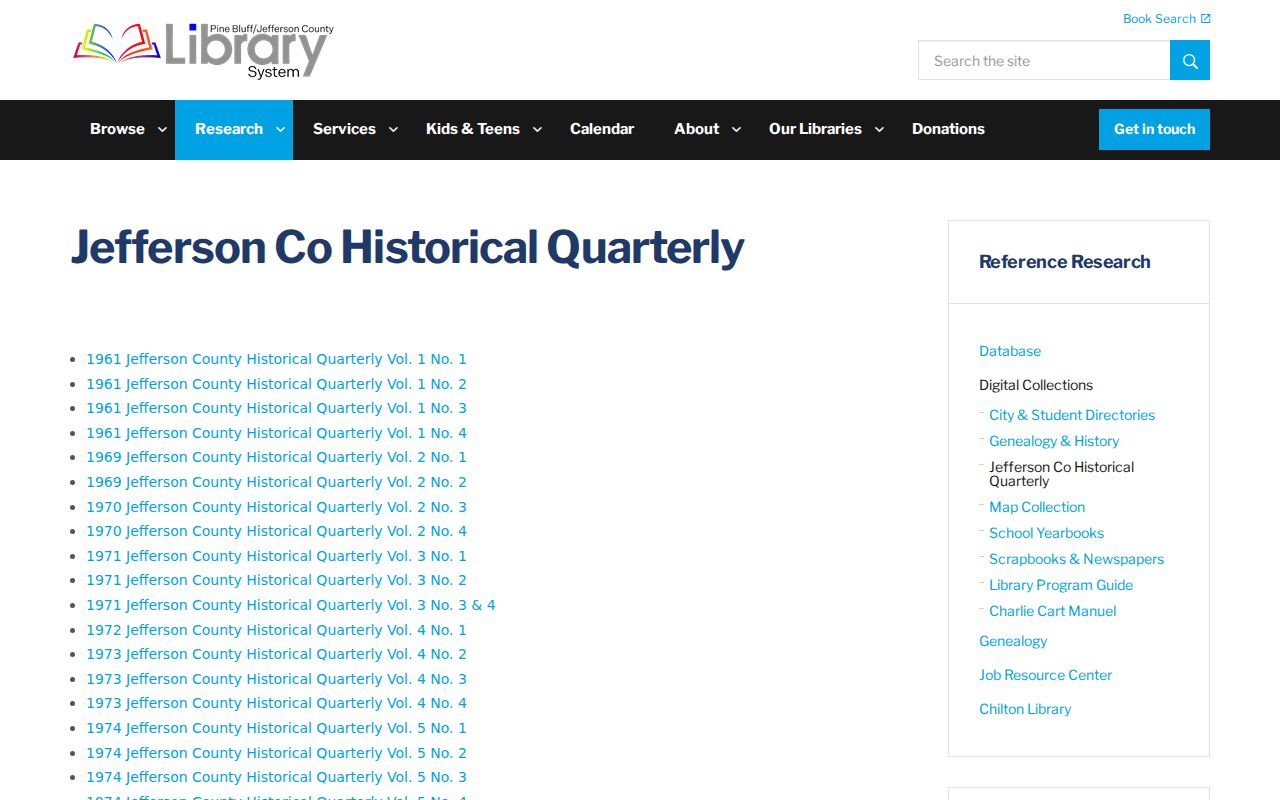
The issue list can supply context that alphabetic directories lack, especially for rural-to-city moves, churches, and family names tied to Jefferson County communities.
For a copy request, send the person's name variants, estimated date, edition or newspaper title, page if known, and a return contact. Specific citations save staff time. An index hit is not the full obituary or article, so request the image before relying on its facts.
Pine Bluff Yearbook Bridges
School and college books can reconnect a classmate or distinguish two people with the same name. PBJCLS has deep Pine Bluff High coverage, plus runs for Merrill, Dollarway, Townsend Park, and Watson Chapel. Its reunion books can reveal a married surname or a later place, but they remain publication snapshots. Missing annuals are real collection gaps, not proof that a student was absent.
UAPB and its earlier AM&N identity add another strong layer. The UAPB University Museum and Cultural Center holds the Keepers of the Spirit collection in Childress Hall. Photographs, catalogs, yearbooks, letters, portraits, and artifacts span about 150 years. Research is by appointment with at least five business days' notice, supervised, and noncirculating. Call 870-575-8230 or 870-575-8234 for access.
Match a portrait name and class year to a nearby Pine Bluff directory volume, then test relatives and addresses through newspapers or census records. This human trail is more reliable than forcing a modern identity onto an old school photograph.
Map Pine Bluff Directory Addresses
An address may stay in print while its civic setting changes. PBJCLS supplies Pine Bluff maps dated 1864, 1868, and 1957. The Library of Congress holds an eight-sheet March 1889 Sanborn set. Sanborn maps show building footprints and uses, not household identity. Compare the street name, street reach, and structure first, then return to the directory and deed.
County Clerk files for annexations, incorporations, improvement districts, and rights-of-way explain why one place can shift between rural and city administration. Ask the Jefferson County Clerk for a bounded date range and the territory or road name. The absence of a verified full street-renumbering list makes this record-by-record method important.
For modern address-keyed work, use the Pine Bluff street directory. Historical volumes answer who was printed at a place; parcel and deed sources answer legal ownership and land identity.
Note: A directory address is evidence from one edition, while a map footprint and a deed each document a different fact.
Pine Bluff Records Timeline
Historical directories sit inside a longer local record trail. Jefferson County formed in 1829, long before Arkansas began statewide vital registration in 1914. Deeds, county court books, probate, marriages, newspapers, and federal schedules therefore carry the early burden. Pine Bluff's known scanned evidence starts in 1917, but established genealogy catalogs identify earlier titles that still need title-page checks.
| 1829 | Jefferson County formed; county record groups begin the long local trail. |
|---|---|
| 1864 to 1868 | Pine Bluff Freedmen's Bureau records document people, complaints, work agreements, and marriages. |
| 1914 | Arkansas statewide vital registration begins. |
| 1917 | First year in the PBJCLS online city directory set. |
| 1963 | Latest year in the nine-volume digital directory set. |
| 1975 to 1976 | Major county records were microfilmed before the courthouse fire; exact losses are not established. |
The courthouse fire must be described with care. It did not erase every county record. Extensive nineteenth-century material survives, and 1975 filming created a vital copy of major runs. The Arkansas State Archives adds catalogs, county manuscripts, newspapers, photographs, and government records.

The archive screen represents the next access channel when a local scan, shelf volume, or microfilm reel cannot settle a Pine Bluff identity question.
Judge Pine Bluff Directory Evidence
A directory records what a publisher gathered for an edition. It is not a legal residence certificate for one exact day. A person may be unlisted, misspelled, listed under a household head, or captured after a move. Trade lines can also lag. Compare the claim with a census page, newspaper item, deed, probate paper, obituary, yearbook, or vital record as the question requires.
Pine Bluff's African American history also calls for wider sources. Freedmen's Bureau records for the Arkansas River District include hired-person registers, complaints, and marriage register or certificate copies from 1864 through 1868. Church, military, cemetery, cohabitation, and newspaper sources may name people whom property rolls and household-head directories missed.
Best evidence. Keep the edition, printed page, scan image, exact entry, and abbreviation key together, then record any conflict instead of silently choosing one source.
The result is a defensible family-history trail. It preserves what the Pine Bluff scanned books actually say, identifies each gap, and shows where another custodian or collection supplied the next fact.