
Pine Bluff Previous-Resident Sources
A backward address search works best when each source is used for the fact it was made to record. Jefferson County deeds establish legal ownership. Pine Bluff directories suggest who was listed at an address. Census schedules identify a household at one decennial count, while newspapers, probate files, permits, and maps explain changes between those fixed points.
| Address-history source | Local span | Keeper or access point | Evidence supplied |
|---|---|---|---|
| Deeds and grantor/grantee books | From county formation in 1829, subject to surviving records | Jefferson County Circuit Clerk/Recorder | Recorded owners, legal description, transfer references |
| Digitized Pine Bluff directories | Nine editions, 1917 through 1963 | Pine Bluff/Jefferson County Library | Listed occupant, spouse, work clue, street address |
| Other directory microfilm | 1908 through 1960 in listed intermittent years | St. Louis County Library cataloged run | Fills gaps around local scans |
| Federal census schedules | 1830 through 1950 as applicable; most 1890 schedules lost | NARA and library databases | Household members, relationships, and tenure fields |
| Local newspapers | Various runs from the 1820s | PBJCLS microfilm and copy service | Moves, sales, deaths, and social notices |
| Sanborn maps | Multiple editions; exact year must be checked | Library and Library of Congress | Building footprint, use, street number, and block context |
| Building and code files | Official start year not located | Pine Bluff Inspection and Zoning request | Work, applicant, contractor, dates, and status |
For a recent Pine Bluff address, start with the parcel and deed. For an early twentieth-century address, move quickly between directory, census, map, and deed. The source closest in time is not always the strongest source for identity.
Start Pine Bluff Previous-Resident History
The current parcel card is the stable entry point for previous residents. Search the Jefferson County real-property system by street address. Save the parcel number, present owner, owner mailing address, property situs, subdivision, and full legal description. The situs is the physical parcel location. The mailing address is where tax mail goes. They can differ without proving who occupied the site.
Street spelling changes. Directional prefixes and unit formats also drift. If an exact search fails, try the number and street name without the type, then search the street alone. Once found, use the parcel number for later checks because it is more stable than the postal wording.
The current roll is only an anchor. Assessment values and homestead indicators are clues tied to tax administration. A prior deed, directory entry, or census record is still needed before naming past residents.
Note: Preserve the record date and both address forms so a later contradiction can be traced to the source that created it.
Trace Pine Bluff Previous-Resident Deeds
The Jefferson County Circuit Clerk is the ex-officio recorder. Its official page does not advertise a remote deed index or an online cutoff. Call 870-541-5306 or visit Suite 104 at 101 W. Barraque Street on weekdays from 8:30 a.m. to 5 p.m. Ask for the grantor/grantee index, deed books, mortgages, releases, liens, plats, and easements connected to the legal description.
- Copy the current owner, parcel number, and legal description from the assessor card.
- Ask the recorder for the deed by which that owner received title. Save its instrument number or book and page.
- Read the grantor, who is the person or entity transferring the interest. That name identifies the immediately prior recorded owner.
- Search that prior owner as a grantee to locate the deed by which the person acquired the same land. Match the legal description before accepting it.
- Repeat the cycle. Move to physical index books or microfilm when the available electronic path ends.
A street address alone is weak in old deed work. Jefferson County instruments are indexed chiefly by parties and legal land descriptions. Give staff name variants, a rough recording span, subdivision, lot and block, parcel number, and any known book/page reference. The official page does not publish ordinary or certified-copy prices, so ask before ordering.
- Grantor
- The party transferring a recorded property interest.
- Grantee
- The party receiving that interest.
- Chain of title
- The linked sequence of recorded transfers for the same land.
- Legal description
- The land description, often lot and block or metes and bounds, that survives street-name changes.
Pine Bluff Deeds Beyond the Web
The lack of a published recorder portal is not a dead end. It changes the access order. Contact the recorder with a prepared identifier packet, then use the counter, a copy request, physical grantor/grantee books, or available microfilm. FamilySearch catalogs Jefferson County deed records and indexes from 1830, though images may require a login or affiliate-library access.
Pine Bluff has an important preservation clue. The city's official timeline says the courthouse burned in 1976. Major deed, court, and probate runs had been filmed in 1975. That sequence makes microfilm valuable, but it does not prove that every record was lost or that filming occurred because of the fire. Describe any early span as surviving or microfilmed coverage until the clerk confirms the original.
The Pine Bluff library genealogy resources provide local databases and routes to archival material.
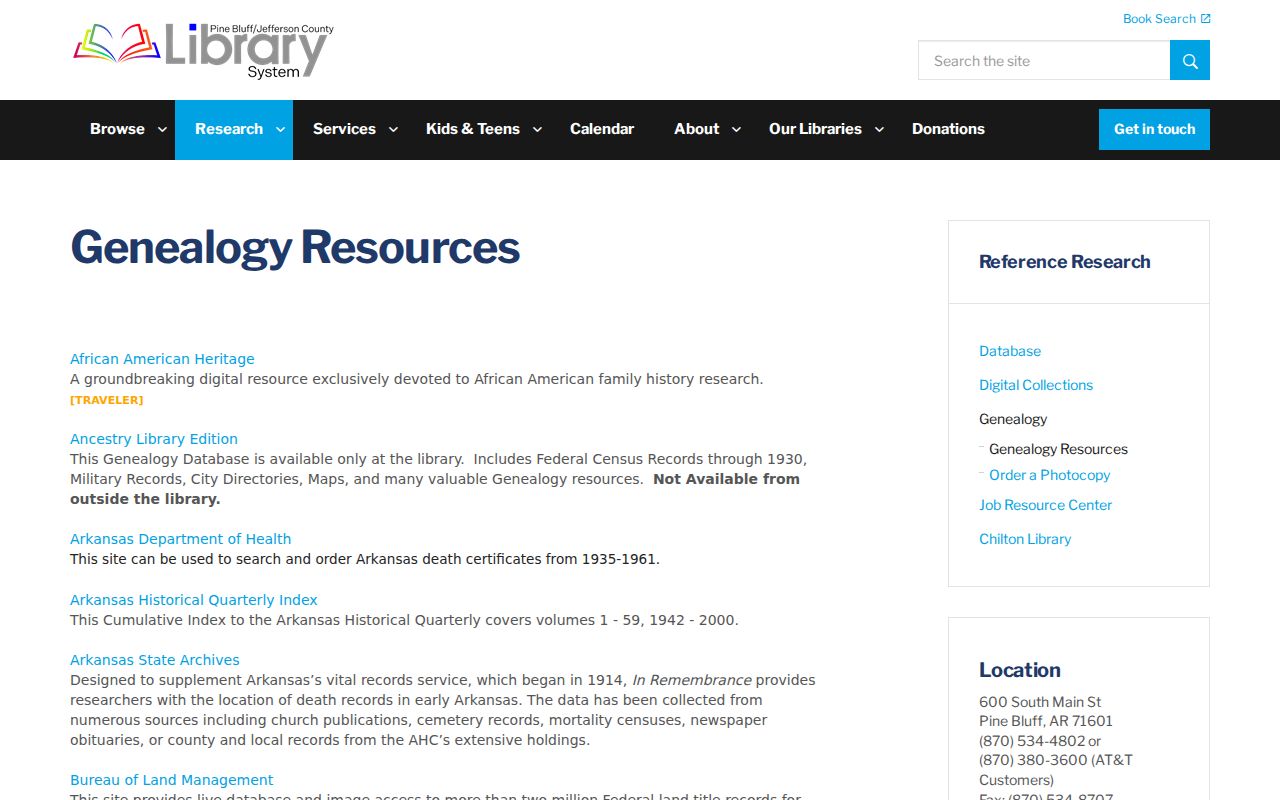
The captured library resource page supports the handoff from online discovery to local collections when the recorder trail or family evidence is not fully digital.
Pair Pine Bluff Directories and Census
Deeds name owners, not every person connected to an address. The Pine Bluff/Jefferson County Library provides free directory scans for 1917, 1922, 1927, 1929, 1931, 1936, 1953, 1958, and 1963. The sequence is not annual. Listed names, spouses, occupations, and exact street forms can place previous residents near a census year, but each entry remains a publisher's snapshot.
- Start with the directory edition closest to the event or deed. Record the exact spelling, spouse, work clue, address, edition, and scan page.
- Check the edition before and after it. A gap may show a move, an omission, a name variant, or a change in street form.
- Pair 1917 or 1922 with the 1920 census; pair 1927, 1929, or 1931 with 1930; pair 1936 with 1940; pair 1953 with the public 1950 census.
- Compare all household names and relationships. Keep a conflict open until another source supports one reading.
- If a person disappears, turn to the obituary index, newspaper microfilm, probate files, and the next deed.
The 1950 census is the latest public federal population schedule as of 2026 under the 72-year release rule. Most 1890 population schedules were destroyed nationally. Other Pine Bluff directory microfilm years cataloged outside the local digital run can fill some gaps. The collections and entry conventions are treated in depth on the Pine Bluff Directory Book page.
Map Pine Bluff Previous-Resident Addresses
Maps answer a different part of the previous-residents problem. The Pine Bluff library has local maps dated 1864, 1868, and 1957. The Library of Congress holds an eight-sheet March 1889 Sanborn set. A Sanborn fire-insurance map can show a structure's footprint, use, street number, and nearby features at the time the sheet was made. It dates the mapped building context, not the person inside it.
Compare the historic street name and number with the modern parcel's legal description. Then consult County Clerk annexation, incorporation, right-of-way, and improvement-district files if jurisdiction changed. Pine Bluff research did not locate a complete official street-renumbering list. A missed address therefore calls for more variants, maps, and legal-land evidence, not a claim that the household moved.
City Inspection and Zoning can also be asked for a permit application, permit card, inspection log, certificate of occupancy, or code case for one exact address and bounded date range. No official public permit-search database or archive start year was found. Lead with the written request, phone, or counter route.
Close Pine Bluff Resident Trails
When a past resident vanishes from the next directory, the Pine Bluff library's obituary index and newspaper microfilm can explain a death, move, family event, or sale. Its newspaper runs reach into the 1820s, and staff provide reader/printer help and accept photocopy orders. Search name variants, spouse, approximate date, address, funeral home, and adjoining family names rather than relying on one spelling.
The Jefferson County Clerk keeps probate instruments. An estate petition, notice, inventory, or order may connect heirs to a transfer. Ask for the decedent name, approximate death date, and probate case or book reference if known. The clerk also keeps county-court material that can explain annexation and right-of-way changes around the property.
For earlier African American Pine Bluff families, NARA's Freedmen's Bureau Arkansas River District records include hired-person and employer registers, complaints, and marriage register or certificate copies from 1864 to 1868. These sources can restore personal links where property and household-head directories omit them.
Lawful use. Research Pine Bluff previous residents for genealogy, estate work, preservation, and personal history. Never use a living person's details to stalk, harass, impersonate, trespass, or defeat an address-protection program.
Document Pine Bluff Previous Residents
A sound address-history file keeps every searched spelling, the current parcel citation, complete legal description, deed book and page, directory edition and page, census enumeration district and sheet, obituary citation, and each unresolved conflict. That audit trail matters in Pine Bluff because the owner, listed occupant, postal city, ZIP, ward, school district, and incorporated jurisdiction can all differ for valid reasons.
Give priority to records created closest to the fact. Use the deed for title, the directory for its listed address, the census for its count date, and the map for the structure shown. Do not choose the newest database just because it is easy to open. Two independent matches are safer when names repeat.
Previous residents become clearer when each conclusion states both the evidence and its limit. A directory can place a named person at a street line for one edition. It cannot certify the exact move date. A deed can establish ownership. It cannot name every person in the household. Keeping those lines sharp produces a Pine Bluff history that another researcher can check.
Note: Mark uncertain links as tentative and ask the record custodian for the original image or certified copy when the distinction matters.