
Pine Bluff Neighbor Records
A block lookup stacks records instead of leaning on one. Jefferson County organizes land by parcel, not household. So start with the parcel record. The assessor card names an owner and carries a physical, or situs, address. From there the Collector adds the taxpayer and payment status. A deed confirms the legal transfer behind a single lot. Voter lists release only limited fields through lawful requests. The public self-check cannot browse a block. For earlier generations, historical directories list past residents in street order. Watch-group contacts reveal civic activity without exposing private membership.
| Block source | Clue it gives nearby | How to reach it |
|---|---|---|
| Jefferson County parcel map and assessor | Lot position, situs, parcel, owner, mailing address, legal facts | Free DataScout map and card |
| Jefferson County tax roll | Taxpayer, tax year, assessment, amount and payment status | Free county tax portal or Collector counter |
| Circuit Clerk deeds | Transfers, easements and legal interests affecting a lot | Suite 104 counter or copy request |
| County Clerk voter list | Only fields Arkansas law permits, with protected addresses removed | Specific request to the clerk |
| Street-order directories | Earlier occupants listed by house number when an edition has that section | Library scans, microfilm and staff help |
| Watch and civic contacts | Public officers, meetings, boundaries and events | Public city or regional pages |
Every row answers a different question. An owner name is not a census of the address. A taxpayer may receive mail somewhere else entirely. A voter record covers one registered voter and shields protected fields. The sound result is a small set of well-labeled clues. It never claims the whole block has been counted.
Map Pine Bluff Neighbors
The Jefferson County DataScout map supports the easiest Pine Bluff neighbor workflow. Find one parcel you already know. Zoom until the street and lot lines read clearly. Then inspect each lot that touches it. Check every lot across the road too. Assume no radius or buffer tool exists; manual browsing is the fallback. That hands-on habit also keeps you aware of which polygon you actually clicked.
- Search the known street address or parcel. Open its parcel summary and record the parcel number, situs and owner separately.
- Zoom to block scale. Click every polygon sharing a side with the subject lot, then click the lots across the street one by one.
- Open each linked parcel card. Record the owner, mailing address and legal description without inferring facts from label placement.
- Compare each parcel with the tax roll. Follow only the lots that matter into deed or directory research.
The flow repeats itself. Address becomes parcel, parcel becomes adjoining lots, each lot leads to its card, and chosen names end at a custodian record. Keep in mind that parcel outlines are tax graphics. They are not surveys. They prove no legal boundary. For walking one named road in full, the Pine Bluff street directory carries the broader method.
Note: Write down each parcel number as you go, because street labels and mailing formats vary while the county key stays stable.
Pine Bluff Block Tax Clues
A second official layer sits beside the parcel map: the Jefferson County tax search. Anyone can use it at no charge. Search fields cover business and personal names, street address, tax year, parcel number, taxpayer ID, receipt number and date, property type, school district, and current or delinquent status. That's a lot of filters. Matching a mapped parcel in the Pine Bluff residents directory to its tax record takes only a few clicks.
Read the results carefully, though. A tax account describes the parcel's money trail. It does not confirm who lives there or who paid the bill. The named taxpayer may be an heir. It may be a firm, or someone who moved away long ago. Treat the tax roll as a check on the parcel. It also covers the tax year and the account of record. Nothing more.
Need counter help? Visit the Collector's office in Suite 113 of the Jefferson County courthouse at 101 W. Barraque Street. The office answers its published line, 870-541-5313, on weekdays from 8:30 a.m. to 5 p.m. A visit in person helps when the online portal skips a year. It also helps when two entries seem to point at one parcel.
Pine Bluff Address Records
Keep the owner's mailing address and the parcel's situs in separate columns. Situs is where the land physically sits. Mailing is where the tax statement goes. A match between the two hints at owner occupancy, and a homestead flag strengthens that hint. Even then it cannot show who else is present. A mismatch can flow from vacant land, an estate, business ownership, or a preferred place for tax mail.
- Parcel
- The county's database unit for one tract or tax lot.
- Situs address
- The physical location assigned to the parcel.
- Mailing address
- The destination used for the owner's tax correspondence.
- Legal description
- The land description that identifies the tract apart from its street number.
Those distinctions guard against a classic block-research mistake. Never treat every owner as a current resident. Your final record should read "owner shown on the current Pine Bluff assessor card," not "person living here." That wording stays true even after a card is later corrected.
Pine Bluff Neighbors and Voters
Arkansas VoterView asks for first name, last name and date of birth. A match can return registration, precinct, polling and ballot details. The tool exists so a voter can check their own record. It cannot enumerate a street. A failed match proves no absence from Pine Bluff.
A computerized county voter list follows a separate path. Ark. Code Ann. §7-5-109 requires at least name, address and precinct number in the requested list. Secure-voter protections are excluded from that rule. The Jefferson County Clerk is the voter registrar. Any request should name the exact geography, format, date and public fields sought. Ask the clerk about lawful use and the current fee. The Arkansas Secretary of State voter information page carries the official public guidance. That guidance stands behind the process.
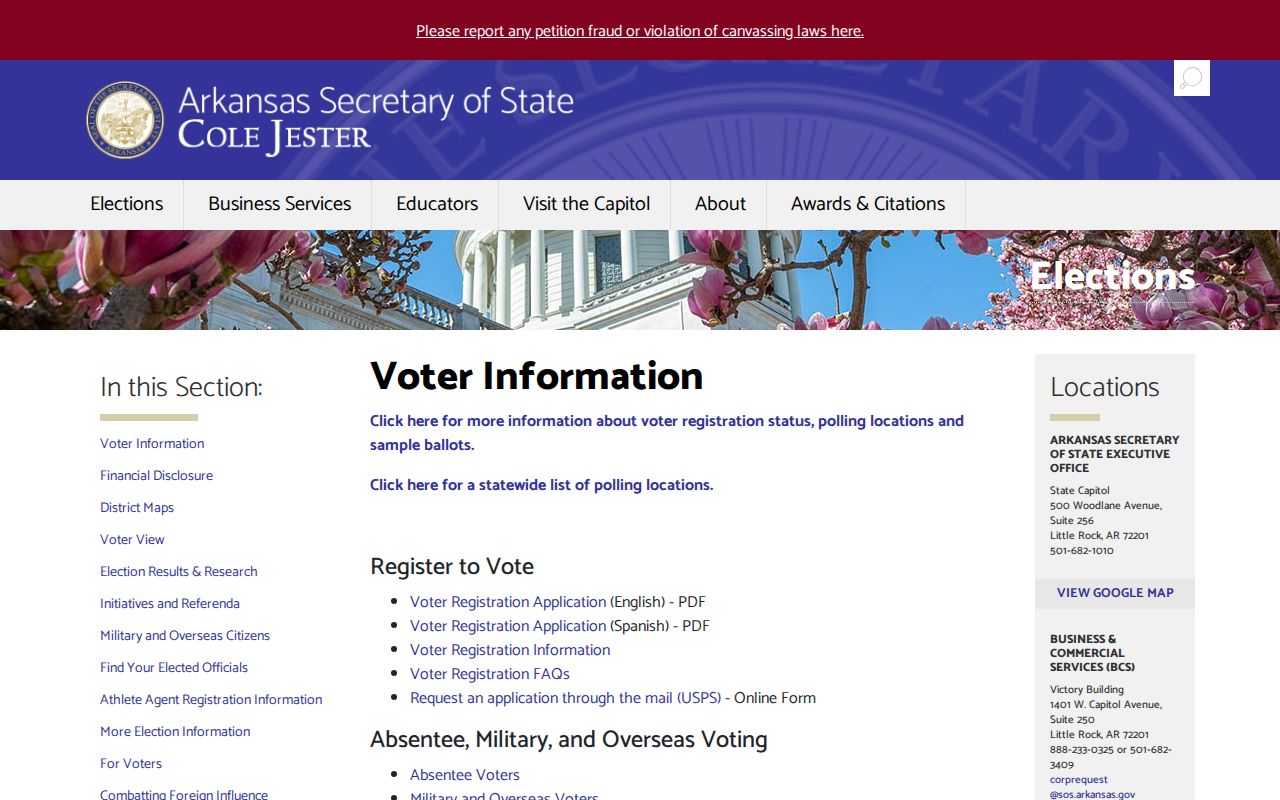
The state's election page lets a voter check registration and precinct details. It is a lookup tool for one person at a time. It does not produce a block roster. So a neighbors search in Pine Bluff belongs with the county clerk and voter rolls, not with repurposing a self-service portal.
Note: Released voting history shows whether someone voted in an election. It never shows which way a ballot was marked.
Pine Bluff Community Directory
The Southeast Arkansas Regional Planning Commission map marks Neighborhood Watch Group territory across Pine Bluff. It also marks HOA territory. City materials also point to watch or revitalization work. Broadmoor, Third Street, Turtle Creek and Central Park all appear in that work. No current member lists are published. Treat those names as starting points for finding a public meeting or an officer. A community group is not a private resident list.
Regional map
Southeast Arkansas Regional Planning Commission
Public watch-group and HOA geography
Watch coordinator
Lt. Hosea Thompson
Pine Bluff Police
870-730-2069
County voter records
Jefferson County Clerk
Suite 101, 101 W. Barraque St.
870-541-5322
A phone call or public contact can settle meeting times, service projects, boundary questions and whether a group is still active. Churches, schools, chambers and watch groups often publish their officers. That is a far cry from a residential roll. Ask the organization what it chooses to share, and respect a "do not publish" request.
Earlier Pine Bluff Neighbors
The Pine Bluff/Jefferson County Library's digitized city directories turn a modern block search into a time machine. Nine scanned editions cover 1917, 1922, 1927, 1929, 1931, 1936, 1953, 1958 and 1963. Many volumes include a street or householder section. That section flips the usual order. Entries group by street number instead of surname, the historical counterpart to clicking through adjacent parcels in a modern residents directory or property roll.
Gaps matter. These editions are not an annual run. A missing name can mean an omission, a move, a changed spelling or the publisher's habit of listing only the household head. Cross-check the address against the nearest census year, newspaper microfilm or a deed. The library's newspaper holdings stretch back into the 1820s, and its obituary index plus copy service can carry a trail forward once a directory entry ends.
Old maps add one more check. The local collection holds Pine Bluff maps dated 1864, 1868 and 1957, and the Library of Congress keeps an eight-sheet March 1889 Sanborn set. Maps show streets and building footprints. They do not name every resident. Pair a map with the directory entry rather than asking one source to do both jobs.
Official Versus Commercial Block Clues
Commercial block tools promise speed. They merge public and commercial data into a tidy result, yet updates can lag and people with similar names can get folded together. Official sources move slower. Each record has a named custodian and a stated purpose. A smart Pine Bluff resident lookup treats the fast result only as a lead, then returns to the assessor, Collector, clerk, library or recorder for the fact that counts.
| Source type | Strength | Limit |
|---|---|---|
| Assessor and parcel map | Current parcel key, situs and owner | Not a household list or survey |
| County tax and voter records | Custodian-backed fields and dates | Access and privacy limits apply |
| Library directory scans | Cited edition and page for an earlier block | Publication gaps and omissions |
| Commercial compilation | Fast lead from mixed data | Source, date and identity may be unclear |
Keep a short audit trail. Write down the source name, access date, parcel or page number and any mismatch so corrections stay possible and a shaky clue never hardens into a false claim.
Limits on Pine Bluff Neighbor Lookups
Public sources have real gaps. A property card names the owner, not everyone in the home. Utility accounts and driver-address files sit outside ordinary directory records. Arkansas also seals vital, juvenile, adoption, sealed-case, and personal-identifier records behind their own restrictions. Under Ark. Code Ann. §7-5-112, a domestic-violence victim can enroll in the secure-voter program. That program has the address pulled from precinct lists and tablets. No neighbor lookup should ever try to get around that shield.
Arkansas has no broad, California-style deletion law that covers every data broker at once. Fixes happen one source at a time. A wrong government record gets corrected through the custodian who holds it. A commercial listing goes through that provider's own privacy process. A record is public. That does not give anyone the right to track, confront, or publish a person.
Lawful use. Pine Bluff block lookups are for civic curiosity, family research, reconnecting and personal safety. Never use a record to stalk, harass, intimidate or evade a protected address.